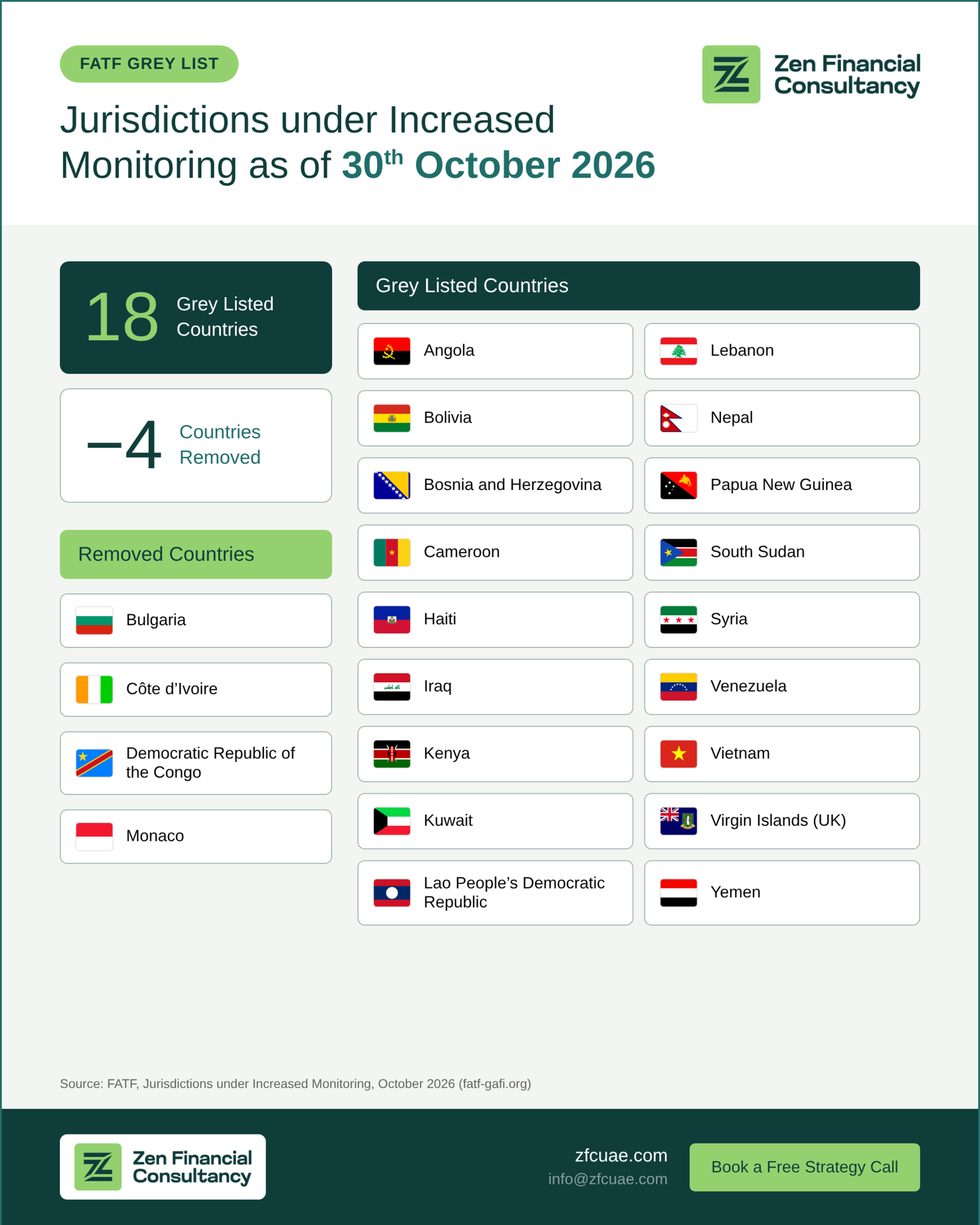
The FATF published updated blacklist and grey list countries on 30 October 2026. Four jurisdictions, Bulgaria, Côte d’Ivoire, DRC and Monaco, were removed from the Grey List, while no new jurisdictions were added. The blacklist remains unchanged. Here are both lists in full and what UAE businesses should do next.
Key takeaways of the FATF Plenary, October 2026
- Grey list additions: None
- Grey list removals: Bulgaria, Côte d’Ivoire, DRC and Monaco
- Grey list total: 18 jurisdictions
- Blacklist: No change
- Plenary held 28–30 October 2026 in Paris, the first under UK President Giles Thomson
FATF blacklist countries as of 30 October 2026
The blacklist, officially “High-Risk Jurisdictions subject to a Call for Action”, is the FATF’s most serious designation:
- Iran
- Democratic People’s Republic of Korea (North Korea)
- Myanmar
| Jurisdiction | FATF Call |
|---|---|
| Iran | Countermeasures |
| DPRK (North Korea) | Countermeasures |
| Myanmar | Enhanced due diligence proportionate to risk |
FATF grey list countries as of 30 October 2026
The grey list, officially “Jurisdictions under Increased Monitoring”, now has 18 entries:
- Angola
- Bolivia
- Bosnia and Herzegovina
- Cameroon
- Haiti
- Iraq
- Kenya
- Kuwait
- Lao People’s Democratic Republic
- Lebanon
- Nepal
- Papua New Guinea
- South Sudan
- Syria
- Venezuela
- Vietnam
- Virgin Islands (UK)
- Yemen
What changed on the FATF grey list in October 2026
Countries added to increased monitoring on 30 October 2026
No countries were added to the FATF grey list during the October 2026 Plenary.
Countries removed from the FATF grey list on 30 October 2026
Bulgaria, Côte d’Ivoire, DRC and Monaco were removed after completing their action plans and passing on-site visits.
FATF grey list vs blacklist: what is the difference?
| Grey list | Blacklist | |
|---|---|---|
| Meaning | Strategic deficiencies, actively being fixed | Serious deficiencies, insufficient progress |
| Cooperation | Agreed action plan with deadlines | Limited |
| Response expected | Risk-based; EDD where warranted | EDD; countermeasures where called for |
| UAE goAML impact | STR/SAR if suspicious | HRC/HRCA reports on in-scope activity |
What UAE businesses should do now
- Whether you are a real estate broker in Sharjah, a gold trader, an accountant or a corporate service provider, the steps are the same:
- Update the geographic risk section of your Enterprise-Wide Risk Assessment.
- Re-rate customers and UBOs linked to the four jurisdictions removed from the FATF grey list and reassess their risk exposure based on the updated country classifications.
- Update your screening tool’s country settings.
- Check whether any activity requires an HRC, HRCA or STR on goAML.
- Train your team on the changes and keep a dated record.
Does the FATF grey list affect UAE customer onboarding?
It affects how you assess the customer, not whether you can accept them. A link to a grey-listed country raises the risk score and may require enhanced checks. Refusing all customers from listed countries is not what the risk-based approach requires.
FAQs on the FATF grey list update, October 2026
What are the FATF blacklist countries in October 2026?
As of October 2026, the FATF blacklist continues to include three jurisdictions: Iran, North Korea (Democratic People’s Republic of Korea) and Myanmar. No countries were added to or removed from the list during the October 2026 Plenary.
Which countries are on the FATF grey list now?
As of 30 October 2026, 18 jurisdictions remain on the FATF grey list: Angola, Bolivia, Bosnia and Herzegovina, Cameroon, Haiti, Iraq, Kenya, Kuwait, Lao People’s Democratic Republic, Lebanon, Nepal, Papua New Guinea, South Sudan, Syria, Venezuela, Vietnam, Virgin Islands (UK) and Yemen.
Which countries were added and removed in October 2026?
No countries were added to the FATF grey list during the October 2026 Plenary. Four jurisdictions, Bulgaria, Côte d’Ivoire, the Democratic Republic of the Congo and Monaco, were removed after completing their action plans and passing on-site visits.
What is the difference between the FATF grey list and blacklist?
Grey-listed countries are cooperating with the FATF to fix deficiencies; blacklisted countries have serious unresolved deficiencies and face EDD or countermeasures.
Does grey-listing mean sanctions?
No. It is not a sanction and does not by itself require automatic EDD; it calls for a risk-based response.
Unsure about the latest FATF updates?
Find out how the October 2026 changes affect your AML obligations, with support from Zen Financial Consultancy.

Hetal Kundalia
Hetal Kundalia brings deep expertise in anti-money laundering compliance, with a focused understanding of the UAE’s regulatory environment. She has worked across sectors, including financial institutions, DNFBPs, VASPs, and emerging fintechs. She has supported them in designing AML frameworks that are not just compliant on paper but operationally sound under review.
She holds the ICA / MOET certification in AML/CFT for DNFBPs and applies that training to real-world compliance delivery. Her work reflects the regulatory priorities of the FIU, DIFC, VARA, MoET, MoJ, and Central Bank, while aligning with FATF recommendations and UAE AML laws.
Hetal leads advisory across all our core services from enterprise-wide risk assessments and control design to CDD strategy, transaction monitoring, governance structuring, and remediation support. She works directly with MLROs and compliance teams to identify gaps, strengthen documentation, and prepare programs for regulatory scrutiny. Her work reflects a simple principle: doing the work in a way that stands up, holds together, and makes sense.
Expert Strategies, Industry Trends & Real Results